Contractor Tips from BladeGuy Pro
Cutting concrete isn’t just about getting through the slab — it’s about hitting the right depth for the right purpose. Too shallow and the joint fails. Too deep and you waste blade life, time, and risk structural damage. Here’s how pros choose the correct depth every time.
Here’s how professional contractors determine proper cutting depth.
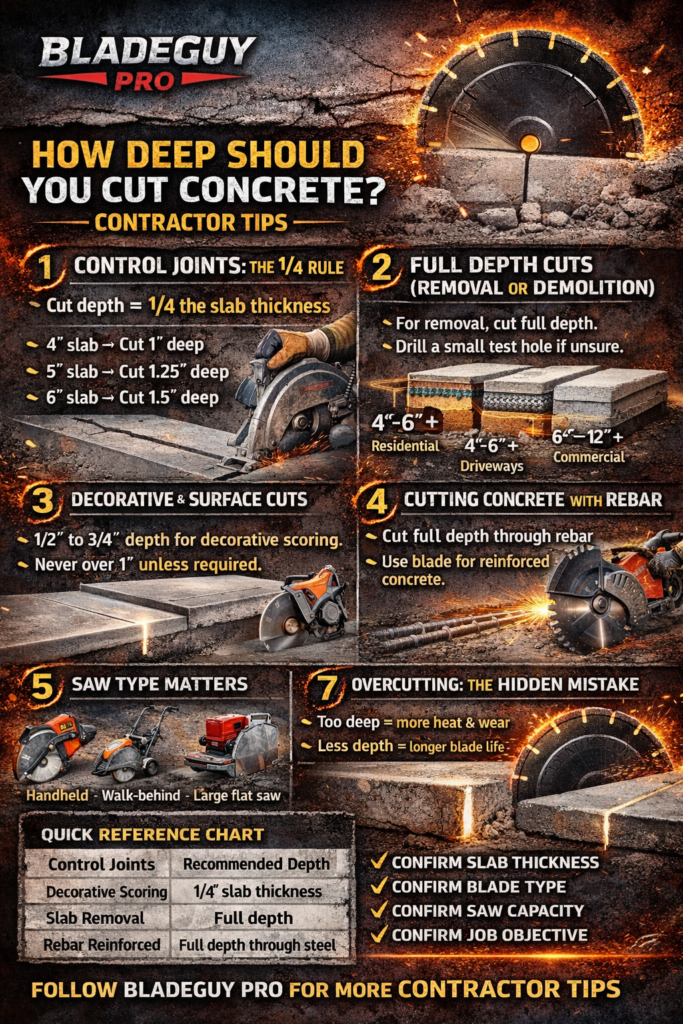
1️⃣ Control Joints: The 1/4 Rule
If you’re cutting control joints in freshly poured concrete, the industry standard rule is:
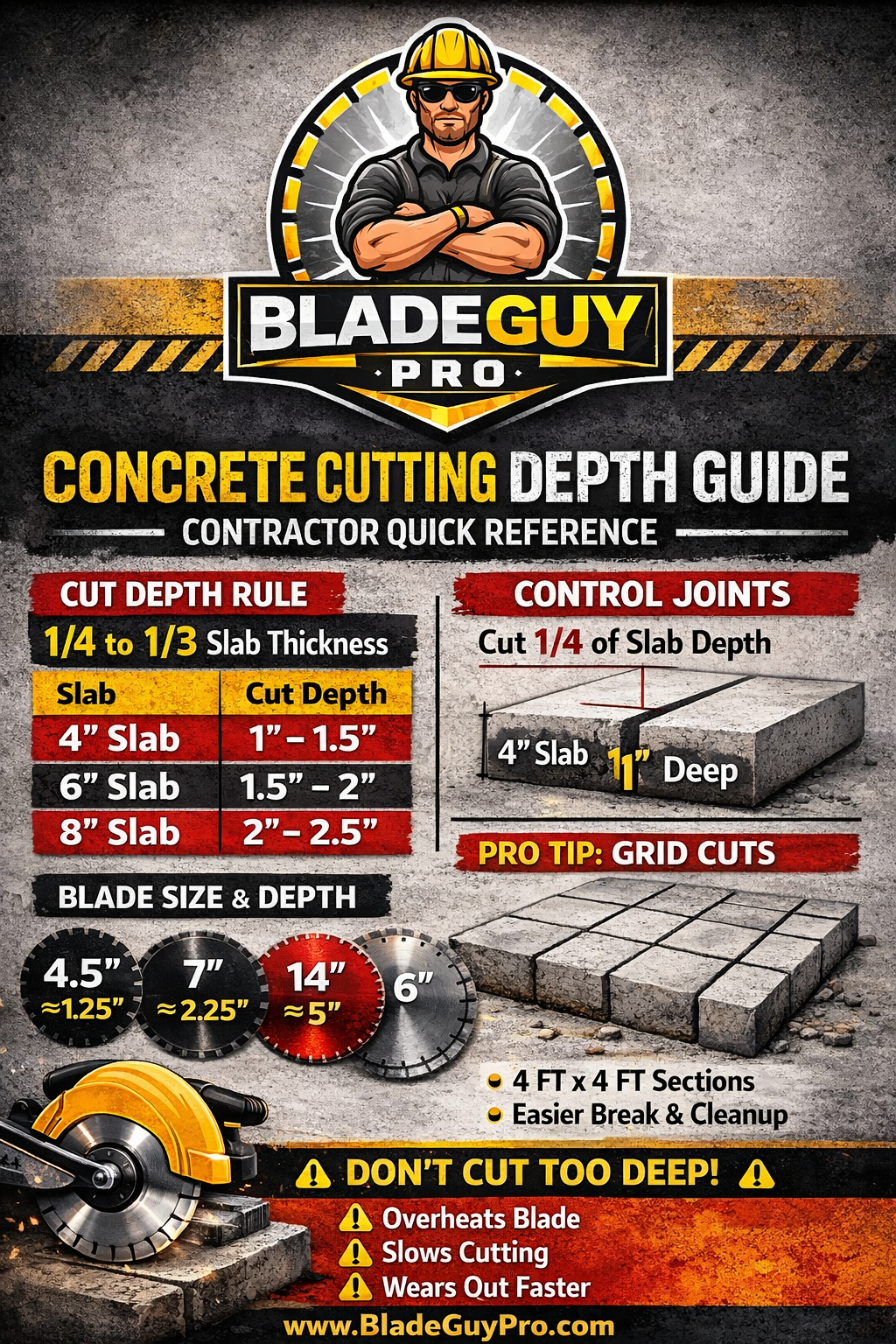
Cut depth = 1/4 of the slab thickness
Examples:
- 4” slab → Cut 1” deep
- 5” slab → Cut 1.25” deep
- 6” slab → Cut 1.5” deep
Why?
Concrete cracks naturally. Control joints create a weak point so the crack forms where you want it — not randomly across the slab.
If you cut too shallow:
- The slab may crack outside the joint
- You lose structural control
If you cut too deep:
- You weaken the slab unnecessarily
- You increase blade wear and labor
2️⃣ Full Depth Cuts (Removal or Demolition)
When removing concrete, your goal is usually a full-depth cut.
Standard Residential Slabs:
- 4” – 6” thick
Driveways:
- 4” – 6” typical
- 6”+ in heavy-load areas
Commercial / Industrial Slabs:
- 6” – 12”+ depending on design
Pro Tip:
If you’re unsure of slab thickness, drill a small test hole near the cut line before committing to full-depth cutting.
3️⃣ Decorative & Surface Cuts
When scoring decorative lines or shallow grooves:
- Typical depth: 1/2” to 3/4”
- Never exceed 1” unless structurally required
These are aesthetic cuts — not structural separation cuts.
4️⃣ Cutting Concrete with Rebar
If you’re cutting reinforced concrete:
- Expect embedded steel
- Cut deep enough to fully sever rebar
- Use a blade designed for reinforced material
Trying to “barely clear” the steel causes:
- Blade glazing
- Segment damage
- Excessive heat
A high-performance diamond blade designed for reinforced concrete makes a huge difference here.
5️⃣ Saw Type Matters
Different saws control depth differently:
- Handheld saws – Best for shallow to mid-depth cuts
- Walk-behind saws – Ideal for precise control joint depth
- Large flat saws – Used for deep industrial cuts
Always verify max depth capacity before starting the job.
6️⃣ Overcutting: The Hidden Mistake
Many contractors overcut corners to ensure separation. While sometimes necessary, excessive overcutting:
- Weakens slab corners
- Creates visible cosmetic flaws
- Increases repair liability
Cut precisely and finish corners carefully when possible.
7️⃣ Depth Affects Blade Performance
Cutting deeper than needed:
- Increases friction
- Builds heat faster
- Wears diamonds prematurely
- Reduces overall blade life
- Slows down mid-cut
Professional contractors know:
Correct depth = longer blade life + faster production.
Quick Depth Reference Chart
| Application | Recommended Depth |
| Control Joints | 1/4 slab thickness |
| Decorative Scoring | 1/2†– 3/4†|
| Slab Removal | Full depth |
| Rebar Reinforced | Full depth through steel |
Final Contractor Advice
Before cutting:
✔ Confirm slab thickness
✔ Confirm blade type
✔ Confirm saw capacity
✔ Confirm job objective
Concrete cutting is about control — not just power.
Need the Right Blade for the Job?
BladeGuy Pro supplies high-performance diamond blades engineered for:
- Control joint cutting
- Reinforced concrete
- Asphalt
- Demolition
- Multi-material applications
If you want cleaner cuts, longer blade life, and fewer jobsite headaches — start with the right blade.
Follow BladeGuy Pro for more contractor tips and professional cutting advice.