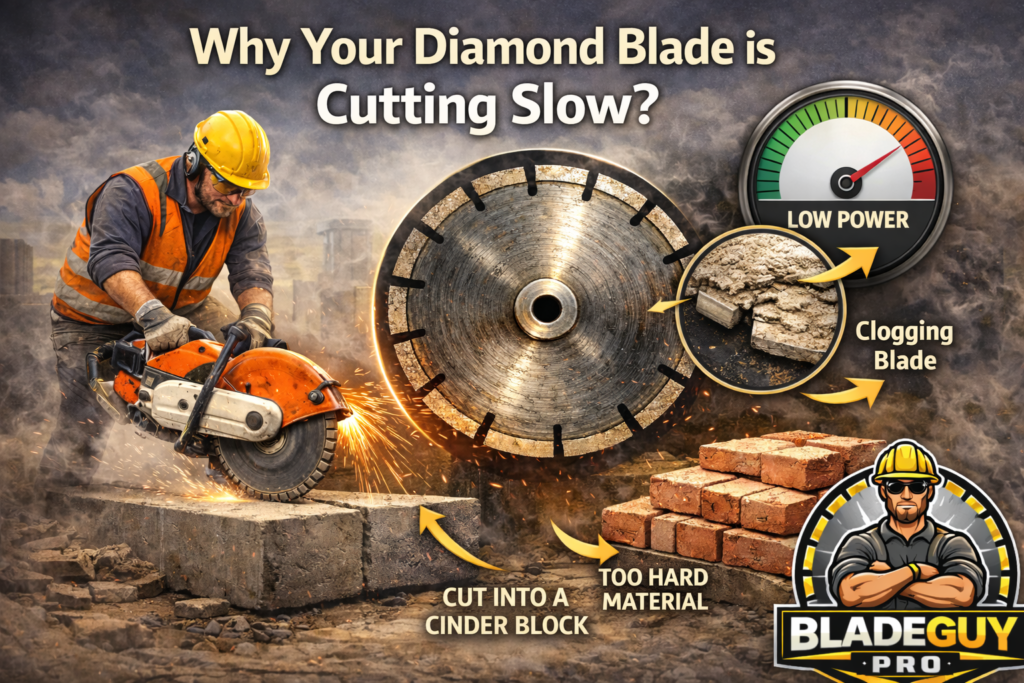
Few things are more frustrating on a jobsite than a diamond blade that suddenly stops cutting efficiently. Many contractors assume the blade is worn out, but in most cases the problem is something else.
The Blade Is Glazed
Diamond blades cut when the metal bond wears away and exposes fresh diamonds. If the bond becomes too hard for the material being cut, the diamonds stop being exposed. This condition is called glazing.
Signs of a glazed blade include:
- Slow cutting
- Excessive heat
- Smooth shiny segments
- Needing extra pressure to cut
How to Fix It
Often you can fix this by dressing the blade. Make several cuts into an abrasive material such as:
- Concrete block
- Asphalt
- Dressing stone
This wears the bond and exposes new diamonds.
Using the Wrong Blade
Another major cause of slow cutting is using the wrong blade for the material.
Examples include:
- Concrete blade used on asphalt
- General purpose blade used on reinforced concrete
- Hard bond blade used on hard stone
Matching the blade bond to the material dramatically improves cutting speed.
Too Much Pressure
If you find yourself forcing the saw, the blade is either dull or mismatched for the material. Let the blade cut at its natural speed.
Forcing the blade only creates heat and premature wear.
Final Tip
A premium blade may cost more upfront, but it often cuts faster, lasts longer, and reduces labor time, which is where the real money is saved.
2. Asphalt Blades vs Concrete Blades: What’s the Difference?
Many contractors believe a diamond blade can cut anything. While that’s partially true, using the correct blade makes a huge difference in performance and safety.
Asphalt Is Extremely Abrasive
Asphalt contains sand and aggregate that rapidly wear down diamond segments. Because of this, asphalt blades use a harder bond to hold diamonds in place longer.
Larger Diamonds
Asphalt blades typically contain larger diamond particles because scoring marks are not visible in asphalt like they are in concrete.
This allows the blade to remove material faster.
Drop Segment Design
Quality asphalt blades include a drop segment or undercut protection.
This protects the steel core from undercutting, which happens when the asphalt erodes the steel faster than the segment.
Without this protection the blade can fail prematurely.
Concrete Blades Are Different
Concrete is harder but less abrasive than asphalt. Concrete blades use a softer bond so diamonds are released faster and continue cutting efficiently.
Cost Difference
Premium asphalt blades typically cost around $150–$160, while general purpose blades usually fall between $100–$150.
However, using the correct blade often saves money because it lasts longer and cuts faster.
3. Dry Cutting vs Wet Cutting Diamond Blades
When using diamond blades, contractors often ask whether they should cut wet or dry. The answer depends on the material, the saw, and the jobsite conditions.
Wet Cutting
Wet cutting uses water to cool the blade and control dust.
Benefits include:
- Longer blade life
- Less heat buildup
- Reduced silica dust
- Smoother cuts
Wet cutting is commonly used with:
- Concrete saws
- Tile saws
- Masonry saws
Dry Cutting
Dry cutting blades are designed with special segment spacing to allow airflow and cooling.
Benefits include:
- Faster setup
- No water supply required
- Easier jobsite mobility
Dry cutting is common with:
- Handheld saws
- Demo saws
- Small jobsite cutting tasks
Safety Considerations
Dry cutting produces significant silica dust, which can cause serious health problems. Always use:
- Dust control systems
- Respirators
- Proper ventilation
Whenever possible, wet cutting is the safest option.
4. How Long Should a Diamond Blade Last?
One of the most common questions contractors ask is how long a diamond blade should last. The honest answer is that blade life depends on several factors.
Material Being Cut
Blade life varies dramatically depending on material.
Examples:
- Asphalt – highly abrasive, faster wear
- Reinforced concrete – extremely hard
- Block and brick – moderate wear
- Pavers – variable depending on composition
Operator Technique
Blade life can be reduced if the operator:
- Forces the saw
- Cuts too deep too quickly
- Overheats the blade
- Uses incorrect blade type
Experienced operators often get twice the life from the same blade.
Equipment Condition
A poorly maintained saw can also destroy blades quickly.
Check for:
- Worn arbor bearings
- Bent flanges
- Misalignment
- Excessive vibration
These issues can shorten blade life dramatically.
Quality of the Blade
Premium blades usually contain:
- Higher diamond concentration
- Better bonding systems
- Stronger steel cores
This results in longer life and faster cutting.
5. 5 Mistakes Contractors Make With Diamond Blades
Even experienced contractors occasionally misuse diamond blades. Avoiding these common mistakes can save time and money on the jobsite.
1. Using One Blade for Everything
General purpose blades are convenient but rarely optimal. Material-specific blades perform better and last longer.
2. Forcing the Cut
Pushing harder doesn’t make the blade cut faster. It only increases heat and wear.
3. Ignoring Blade Direction
Many blades are directional. Installing the blade backwards can reduce performance and damage segments.
4. Running the Saw at the Wrong Speed
Always check the blade’s maximum RPM rating. Exceeding it can cause blade failure.
5. Buying Cheap Blades
Low-cost blades often wear out quickly, cut slowly, and cost more in labor and downtime.
A quality blade usually pays for itself through improved performance.