
Contractor Diamond Blade Selection Graphic Chart (Save This)
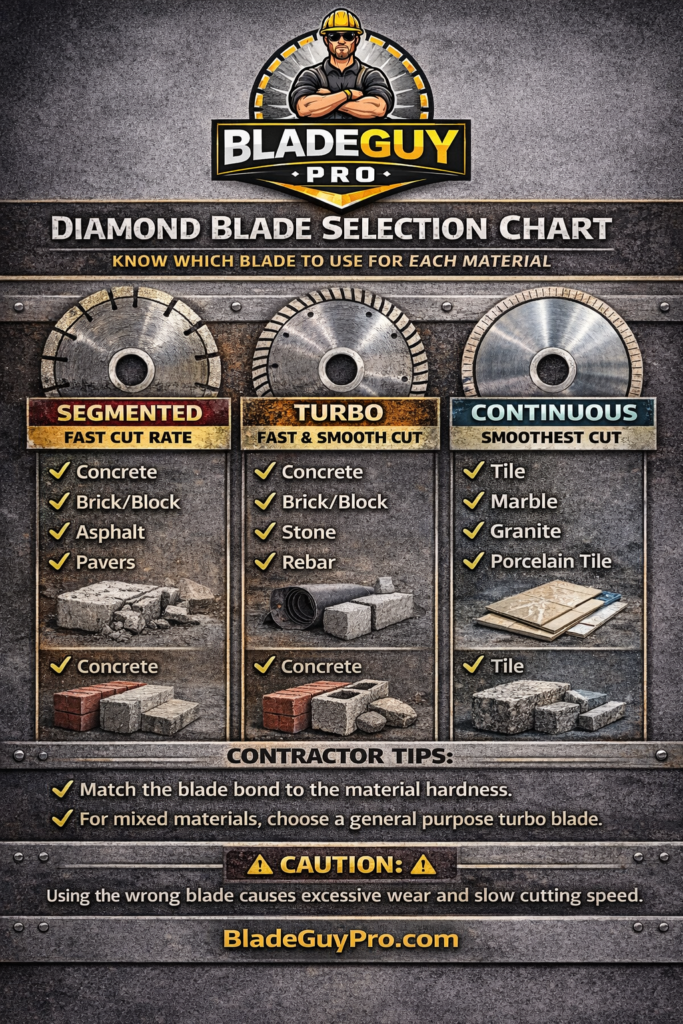
Choosing the right diamond blade is one of the most important decisions a contractor makes on the jobsite. The wrong blade can cut slowly, overheat, wear out quickly, or even become unsafe. The right blade will cut faster, last longer, and save both time and money.
This guide from BladeGuyPro simplifies the process by showing contractors exactly which type of diamond blade works best for common construction materials.
Diamond Blade Selection Chart
| Material Being Cut | Recommended Blade Type | Why It Works |
|---|---|---|
| Asphalt | Asphalt Blade | Hard bond resists highly abrasive material |
| Green Concrete | Soft Bond Concrete Blade | Exposes diamonds quickly |
| Cured Concrete | Medium Bond Concrete Blade | Balanced cutting speed and life |
| Reinforced Concrete | Premium Concrete Blade | Handles steel and aggregate |
| Brick | Segmented Masonry Blade | Fast cutting with good cooling |
| Concrete Block | Segmented Blade | Good balance of speed and durability |
| Pavers | Turbo Rim Blade | Cleaner edges with less chipping |
| Granite | Continuous Rim Blade | Smooth cutting for hard stone |
| Tile | Continuous Rim Tile Blade | Prevents chipping |
| Ductile Iron Pipe | Specialty Diamond Blade | Designed for dense metal |
| Natural Stone | Turbo or Continuous Rim | Smooth controlled cutting |
Understanding Diamond Blade Types
Before selecting a blade, it helps to understand the basic blade designs used in construction.
Segmented Blades
Segmented blades are the most common blades used by contractors.
They feature individual diamond segments separated by gullets that help remove debris and cool the blade.
Best used for:
- Concrete
- Asphalt
- Brick
- Block
- General construction cutting
Segmented blades provide fast cutting and excellent durability.
Turbo Blades
Turbo blades feature a continuous rim with serrated edges.
This design increases cutting speed while producing smoother cuts than segmented blades.
Best used for:
- Pavers
- Concrete
- Stone
- Masonry materials
Turbo blades are popular among hardscape contractors and masons.
Continuous Rim Blades
Continuous rim blades have a solid edge with no segments.
This design produces extremely smooth cuts with minimal chipping.
Best used for:
- Tile
- Granite
- Ceramic
- Porcelain
These blades are commonly used on wet tile saws.
Bond Hardness Explained
The bond is the metal matrix that holds the diamonds in the segment.
Bond hardness must match the material being cut.
General rule:
Hard materials require soft bonds.
Soft abrasive materials require hard bonds.
Examples:
- Hard concrete → soft bond blade
- Asphalt → hard bond blade
If the bond is too hard, the blade may glaze and stop cutting.
If the bond is too soft, the blade may wear out too quickly.
The #1 Blade Mistake Contractors Make
The most common mistake contractors make is using a general-purpose blade for every material.
General-purpose blades work, but they rarely perform as well as material-specific blades.
Using the correct blade can:
- Increase cutting speed
- Extend blade life
- Reduce heat buildup
- Improve safety
The difference in performance can be dramatic.
Contractor Tip: Match the Blade to the Job
Before starting any cut, ask three simple questions:
- What material am I cutting?
- Is the material hard or abrasive?
- What saw and blade size am I using?
Matching the blade to the material will almost always give the best results.
Final Thoughts
Diamond blades are powerful tools that can dramatically increase productivity when used correctly. Understanding blade types, bond hardness, and material compatibility allows contractors to choose the right blade for every job.
Using the correct blade means faster cuts, longer blade life, and fewer problems on the jobsite.
BladeGuyPro Tip:
Bookmark this guide or print the chart for your truck so you always have the right blade selection reference on the jobsite.