
Real Jobsite Cutting Techniques Every Contractor Should Know
bladeguypro.com/ or email us questions info@bladeguypro.com


Real Jobsite Cutting Techniques Every Contractor Should Know
Most contractors think diamond blades are simple tools — put the blade on the saw and cut.
But after 40+ years working with diamond tooling, one thing becomes obvious:
👉 The way you cut determines how fast the blade cuts and how long it lasts.
Two contractors can use the same blade on the same saw, and one blade lasts three times longer simply because of better cutting technique.
This guide covers the cutting techniques professionals use to get maximum performance from diamond blades.
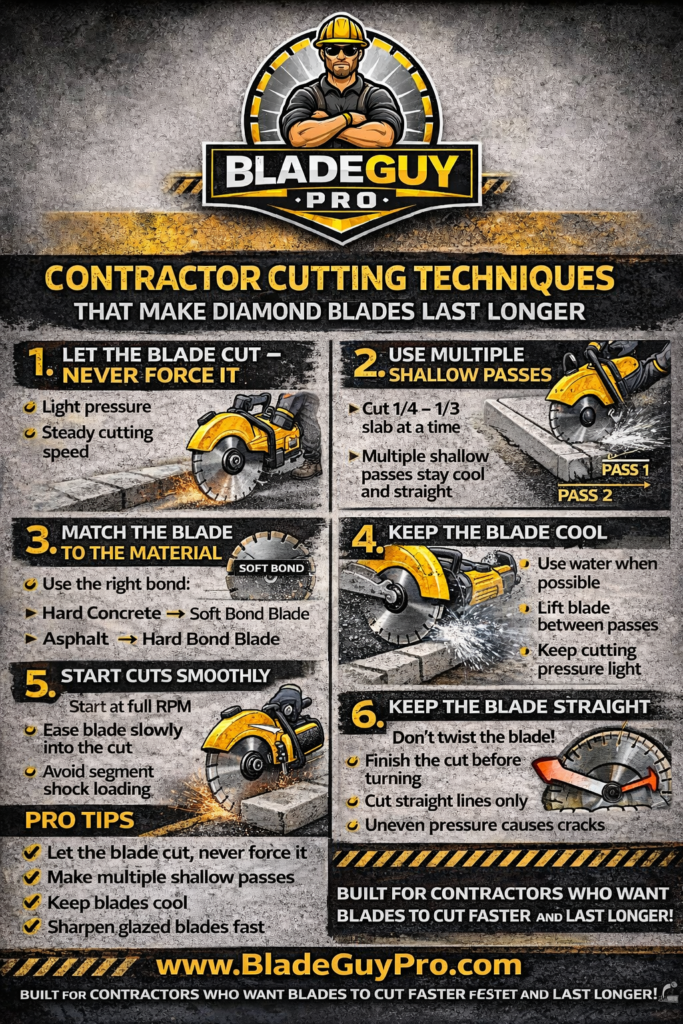
1. Let the Blade Cut — Never Force It
One of the biggest mistakes on a jobsite is forcing the blade through the material.
Diamond blades work by grinding material away, not slicing it like a wood blade.
If you push too hard:
• blade overheats
• cutting slows down
• segments wear prematurely
• saw engine works harder
Correct technique
✔ steady forward pressure
✔ consistent cutting speed
✔ allow blade to maintain RPM
A properly cutting blade should throw a steady stream of slurry or dust, not stall.
2. Use Multiple Shallow Passes
Trying to cut deep in one pass is one of the fastest ways to destroy a blade.
Professional cutters use multiple shallow passes.
Example for a 4-inch slab:
Pass 1 → ¾ inch
Pass 2 → 1½ inches
Benefits:
✔ faster cutting
✔ less blade heat
✔ straighter cuts
✔ longer blade life
This technique is especially important when cutting hard concrete or reinforced slabs.
3. Match the Blade to the Material
Not all diamond blades are the same.
Each blade uses a bond hardness designed for specific materials.
General rule contractors follow:
Hard material → soft bond blade
Soft material → hard bond blade
Examples:
| Material | Blade Type |
|---|---|
| Asphalt | Hard bond blade |
| Green concrete | Medium bond |
| Cured concrete | Soft bond |
| Brick / block | Medium bond |
Using the wrong blade is one of the most expensive jobsite mistakes.
4. Keep the Blade Cool
Heat is the #1 cause of blade failure.
Ways contractors control blade temperature:
• wet cutting when possible
• lifting blade between passes
• avoiding excessive pressure
• allowing blade to spin free occasionally
When dry cutting, give the blade short cooling breaks.
Overheated blades can cause:
• segment loss
• glazing
• warped steel cores
5. Start Cuts Smoothly
Many segment failures happen at the start of a cut.
Never slam the blade into the material.
Correct technique:
✔ start blade at full RPM
✔ slowly ease blade into material
✔ maintain straight alignment
This prevents segment shock loading.
6. Keep the Blade Straight
Diamond blades are designed for straight cutting only.
Twisting the blade causes:
• segment cracking
• blade wobble
• steel core damage
Common causes of blade twisting:
• turning the saw during the cut
• cutting curved lines with straight blades
• uneven pressure
Always finish the cut before changing direction.
7. Sharpen Glazed Blades Quickly
Sometimes a blade stops cutting even though the segments still look good.
This is usually blade glazing.
It happens when:
• bond is too hard for material
• blade overheats
• blade is used on soft material
Quick contractor fix:
Cut something abrasive like:
• cinder block
• asphalt
• dressing stone
This exposes fresh diamonds and restores cutting speed.
8. Use the Correct Saw Speed
Every diamond blade is designed for a specific RPM range.
Running the wrong speed can cause:
• overheating
• poor cutting speed
• blade vibration
• segment loss
Always check the blade’s maximum RPM rating.
Contractor Pro Tips from BladeGuy Pro
Here are some field tips that experienced cutters follow:
✔ Let the blade cut — never force it
✔ Make multiple shallow passes
✔ Use the right blade for the material
✔ Keep blades cool
✔ Sharpen glazed blades quickly
These simple techniques can often double the life of a diamond blade.
Final Thoughts
Diamond blades are one of the most productive tools on a construction jobsite — but only when used correctly.
When contractors apply the right cutting techniques, they get:
✔ faster cuts
✔ longer blade life
✔ safer operation
✔ lower job costs
Learning proper cutting technique is one of the best ways to improve jobsite productivity.
More Contractor Cutting Guides
For more real-world diamond blade knowledge from BladeGuyPro, visit:
You’ll find practical guides on:
- diamond blade troubleshooting
- wet vs dry cutting
- blade sharpening techniques
- contractor cutting tips
Built for contractors who want their blades to cut faster and last longer. 🔧🧱