Cutting asphalt isn’t the same as cutting concrete. The wrong blade can slow your job, wear out prematurely, or even damage your saw. That’s why professional contractors choose asphalt-specific diamond blades over concrete or general-purpose options.
In this post, we’ll break down what makes asphalt blades unique, why their design matters, and how they maximize efficiency, safety, and blade life on every job.
1️⃣ Harder Bond Holds Diamonds Longer
Asphalt is highly abrasive, which can quickly wear down diamond segments. Asphalt blades are engineered with harder bonds that securely hold diamonds in place.
- Why it matters: A hard bond slows diamond loss, ensuring the blade lasts longer and delivers consistent cutting performance.
- Result: Fewer blade changes, less downtime, and reduced inventory costs.
2️⃣ Larger Diamonds for Faster, Cleaner Cuts
Unlike concrete, asphalt doesn’t “score,” so blades need larger diamonds to bite effectively into the material.
- Larger diamonds handle the high abrasion of asphalt without glazing.
- They allow faster cutting while keeping the blade cooler.
- General-purpose or concrete blades with smaller diamonds simply wear too quickly in asphalt applications.
3️⃣ Unique Core Design for Heat Dissipation and Slurry Management
Asphalt blades often feature a specialized core designed to:
- Dissipate heat: Reduces risk of warping or segment loss during heavy cutting.
- Fast slurry clean-out: Keeps cuts smooth and prevents clogging, even in wet or sticky asphalt.
This core design ensures your blade stays efficient from start to finish, even on large paving or repair projects.
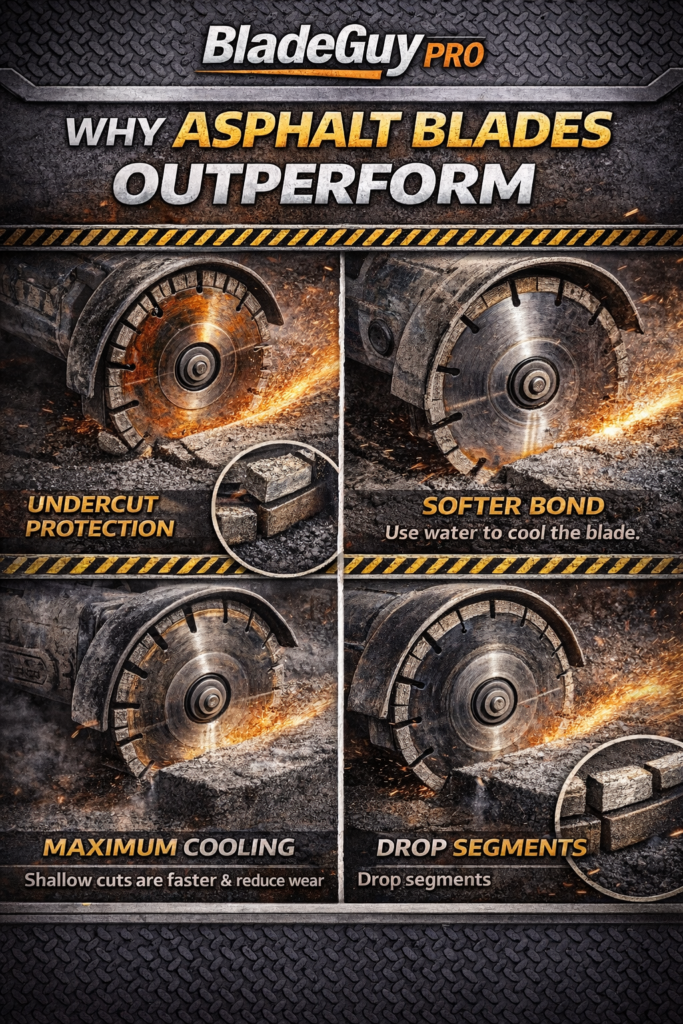
4️⃣ Drop Segment Technology Prevents Undercutting
High-speed cutting and embedded debris can damage blade segments, causing unpredictable cuts or undercutting. Asphalt blades often include drop-segment designs, which:
- Protect the segment welds
- Prevent forecasted undercutting
- Increase safety and extend blade life
This design is particularly critical when cutting thick or reinforced asphalt layers.
5️⃣ Safer for Your Crew
Using the right blade for the material isn’t just about efficiency—it’s about safety.
- Concrete or general-purpose blades can overheat, shatter, or kickback when used on asphalt.
- Asphalt-specific blades reduce risk of blade failure, keeping crews safer on the job.
6️⃣ Cost vs. Value: Premium Asphalt Blades
A professional asphalt blade typically costs $159 each, compared to $100–$150 for general-purpose or concrete blades.
- While slightly more expensive, the longer life, faster cutting, and reduced downtime make the premium asphalt blade more cost-effective over time.
- Fewer blade changes and safer operation mean higher productivity and lower indirect labor costs.
✅ Asphalt Blade vs Concrete / General-Purpose Blade – The Bottom Line
| Feature | Asphalt Blade | Concrete / General-Purpose |
| Diamond Size | Larger, aggressive | Smaller |
| Bond Hardness | Harder for abrasion | Softer for concrete scoring |
| Core Design | Slurry clearing & heat dissipation | Standard |
| Segment Protection | Drop-segment for undercut prevention | Rarely included |
| Safety | Designed for asphalt, reduces failure risk | Higher risk in asphalt |
| Cost | $159 | $100 to $150 |
| Best Use | Asphalt cutting, paving, repairs |
For any contractor working on asphalt, a dedicated asphalt blade isn’t just a choice—it’s a necessity. It reduces downtime, increases cutting speed, improves safety, and maximizes blade life.
🔹 Takeaway
Don’t compromise your crew’s safety or productivity by using a concrete or general-purpose blade on asphalt. With a hard bond, large diamonds, specialized core, drop-segment protection, and safety-focused design, asphalt blades deliver faster cuts, longer life, and safer operation—making the extra cost well worth it.
Upgrade to the right blade and watch your cutting efficiency—and your bottom line—improve.