
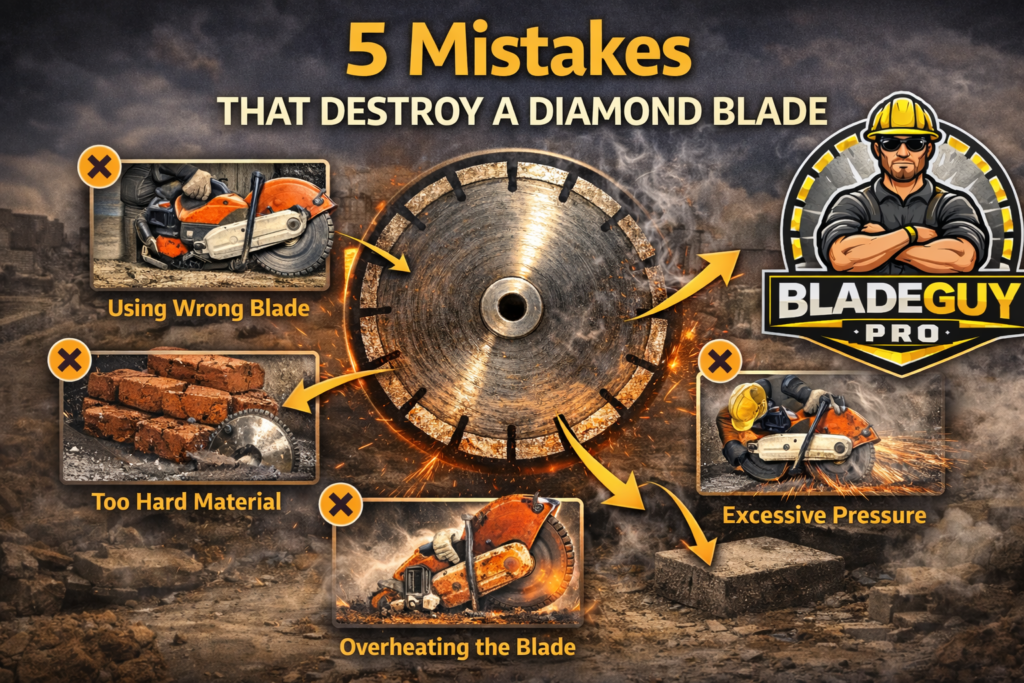
However, many blades fail early because of simple jobsite mistakes. Avoiding these common problems can save money, improve cutting speed, and prevent dangerous blade failures.
Here are five mistakes contractors make that destroy diamond blades.
1. Using One Blade for Every Material
One of the biggest mistakes is using a general-purpose blade for everything.
While general-purpose blades can cut multiple materials, they are rarely the best choice for performance or longevity.
Different materials require different blade bonds.
Examples:
- Asphalt blades use a harder bond because asphalt is highly abrasive.
- Concrete blades use a softer bond so diamonds expose quickly.
- Masonry blades are designed for block and brick.
Using the wrong blade can cause:
- Slow cutting
- Blade glazing
- Excessive wear
- Overheating
Matching the blade to the material can dramatically improve blade life and cutting speed.
2. Forcing the Saw Through the Cut
Many operators think pushing harder will make the blade cut faster. In reality, forcing the saw is one of the fastest ways to ruin a blade.
Diamond blades work by grinding material with exposed diamonds. When too much pressure is applied, the blade overheats and the diamonds dull faster.
Forcing the blade can cause:
- Segment glazing
- Core overheating
- Reduced blade life
- Increased vibration
A properly matched blade should cut smoothly without excessive pressure.
Let the diamonds do the work.
3. Overheating the Blade
Heat is the enemy of diamond blades.
Excess heat can damage both the diamond segments and the steel core. Overheating can lead to:
- Warped blade cores
- Segment loss
- Reduced diamond exposure
- Slower cutting
Overheating often happens when:
- Cutting too deep at once
- Running the saw continuously without breaks
- Dry cutting without airflow
- Using a dull or glazed blade
Allowing the blade to cool periodically or using wet cutting when possible can significantly extend blade life.
4. Ignoring Blade Direction
Many diamond blades are designed to rotate in a specific direction. Manufacturers print a directional arrow on the blade core.
Installing the blade backwards can cause:
- Reduced cutting efficiency
- Poor slurry removal
- Uneven segment wear
While some blades will still cut in reverse, performance is usually reduced.
Always check the directional arrow when mounting the blade.
5. Running the Blade at the Wrong Speed
Every diamond blade has a maximum RPM rating printed on the core.
Running a blade faster than its rated speed is dangerous and can cause:
- Core failure
- Segment loss
- Excessive vibration
- Catastrophic blade breakage
Always confirm that the blade’s maximum RPM rating matches the speed of your saw.
Using the correct blade for the saw is critical for both safety and performance.
Bonus Tip: Inspect Your Blade Before Every Job
Before starting a cut, take a few seconds to inspect the blade.
Look for:
- Missing segments
- Cracks in the steel core
- Warping or bending
- Excessive wear
If the blade looks damaged, do not use it.
A blade spinning at thousands of RPMs must be in good condition to operate safely.
Final Thoughts
Diamond blades are extremely durable tools, but their performance depends on how they are used. Simple mistakes like forcing the saw, overheating the blade, or using the wrong blade for the material can dramatically shorten blade life.
By avoiding these common jobsite mistakes, contractors can get faster cuts, longer blade life, and safer operation.
Taking a few extra seconds to choose the right blade and operate it properly can make a big difference on every job.